How Long to Wait After Changing Thyroid Dose to Check Again
Thyroid hormones are "Goldilocks" hormones: the dose has to be "just right" for usa to feel optimal. Doses that are too loftier or too low can consequence in symptoms.
I go tons of messages from people who study that they had begun to feel hypothyroid symptoms after having their thyroid medications reduced, based on a faulty lab interpretation.
1 lady began to lose her hair in clumps; another became nearly bedridden!
Upon reviewing their labs and history, I realized that both had something in mutual: they had been feeling dandy on a regimen of T4 and T3 medications, but were found to have low TSH levels, which suggests hyperthyroidism or thyroid medication overdosing.
This finding prompted their doctor to reduce their medications.
To forestall this from happening, I recommend doing a total thyroid panel to go the total picture of what's going on with an individual'south thyroid role. In order to get accurate lab tests, still, there are several factors that should be taken into consideration.
This article presents an in-depth discussion on:
- Recommended thyroid lab tests (and WHEN to examination for accurate results)
- How to get accurate results with T4, T3, and T4/T3 combination medications
- Supplements and medications that may affect lab results
- What to practice if you become a questionable lab result
Recommended Lab Tests
When first initiating treatment with thyroid medications for hypothyroidism, guidelines recommend testing thyroid function about 4 to six weeks after the start of the treatment, to determine if the dose of medication is correct. It may be prudent to run these tests sooner and more often if a patient is experiencing symptoms of hypothyroidism, hyperthyroidism, or both.
In addition to looking out for symptoms of hypo- or hyperthyroidism, I also recommend monitoring thyroid levels regularly to ensure the medication dose is still appropriate.
I recommend the post-obit thyroid tests to measure your response to medications:
- TSH (Thyroid Stimulating Hormone) – TSH is a pituitary hormone that responds to low or loftier amounts of circulating thyroid hormone. People with Hashimoto's and fundamental hypothyroidism (a rare blazon of hypothyroidism) may have a normal reading on this exam. In advanced cases of Hashimoto'due south and primary hypothyroidism, this lab exam will exist elevated, every bit the trunk will signal the production of more TSH to cope with the lack of thyroid hormone. (Read this postal service about interpreting the TSH test for more information.) In Graves' disease and hyperthyroidism, TSH levels will be low.
- Optimal reference range: between 0.v-2 μIU/mL
- Free T3 and Costless T4 – Triiodothyronine (T3) is our primary biologically active thyroid hormone. Virtually xx percent of our T3 hormone comes from thyroid secretion directly, while the remaining 80 percent is produced when the thyroid hormone thyroxine (T4) is naturally converted to T3 within our bodies. While T4 is 300 percent less biologically active than T3, it is critical to our body's power to produce adequate and healthy levels of the needed T3. T3 is sometimes chosen our "go" hormone because it tells our body to boost metabolism, grow pilus, and create more energy. Free T3 and T4 tests measure the levels of active thyroid hormone circulating in the body. When T3 and T4 levels are low, but TSH tests are in the normal range, this may lead your doc to suspect primal hypothyroidism.
- Optimal T4 reference range: 15-23 pmol/Fifty
- Optimal T3 reference range: 5-7 pmol/50
If your doctor does not order these tests for you, yous can pay out of pocket and order them yourself through a company similar Ulta Labs.
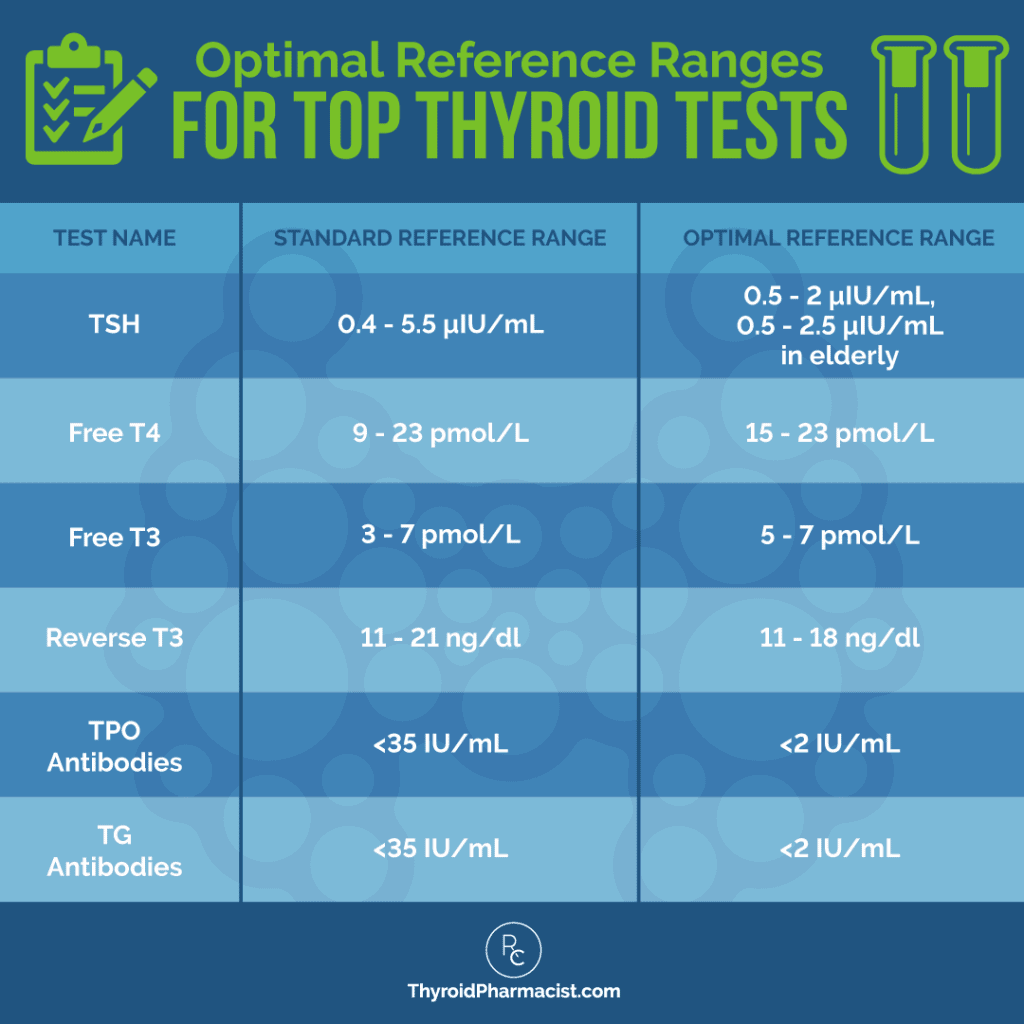
If your thyroid labs appear to exist within the "normal" conventional ranges, but are non in the optimal reference ranges as noted above, you may withal experience thyroid symptoms. (You can acquire more about each of these tests and optimal ranges in my commodity on the tiptop tests for diagnosing and monitoring Hashimoto's.)
Please annotation, however, that depending on the type of thyroid medication you are taking, you may need to time your lab draw and intake of thyroid medication, in order to ensure y'all become the near authentic lab results. (More on that in a minute!)
Optimizing Thyroid Medication Absorption
Before nosotros talk well-nigh timing your lab describe, let's review how to take thyroid medications for proper absorption.
I recommend that you lot take your medication consistently at the same fourth dimension each 24-hour interval, with a drinking glass of water, at least 30 minutes before food. (Most doctors and pharmacists recommend taking them in the morning, upon waking.) Avoid taking acid reflux medications, magnesium, calcium, and iron supplements inside four hours of taking thyroid medication, every bit they tin can impair thyroid medication absorption.
Absorption may likewise be impaired past foods such every bit soybean, cottonseed, walnuts, and fiber.
Beverages (not including water) can impair assimilation likewise. Of note, coffee can reduce the absorption of T4 in the intestines. (The T4 medication Tirosint may exist an exception to this — delight come across my Tirosint article for more than information.)
Yet, hot lemon water is an exception. Taking your thyroid medication with hot lemon water tin offer the acidity needed to aid absorption (and is also great for helping the liver to detox).
Timing Thyroid Medications for Optimal Lab Results
Optimally arresting your thyroid medication will help to ensure the body is getting adequate thyroid hormone, and may improve results when yous do test your labs. However, even if yous are getting adequate thyroid hormone and the body is absorbing it, there are factors that may atomic number 82 to abnormal lab results, and steps yous can take that will ensure accuracy.
The first step to consider is when to have thyroid medications, if you are planning on heading to the lab. The timing of your thyroid medication may affect the accurateness of your thyroid test results, depending on what blazon of thyroid medication it is.
The recommendations for timing thyroid meds differ depending on the type of medication y'all accept. Let's swoop into the recommendations for each type of medication.
Recommendations for Those on T4-Simply Medications
T4-simply medication (such as Synthroid, Levoxyl, Tirosint, Eltroxin, and generic levothyroxine) has a five- to 9-mean solar day half-life, which means that once you have become stable on the electric current dosage, it tin take up to ix days for 50 percentage of the dose to clear the body. T4 has a deadening and steady release and won't produce many fluctuations that can make a person feel like they're on a thyroid roller coaster.
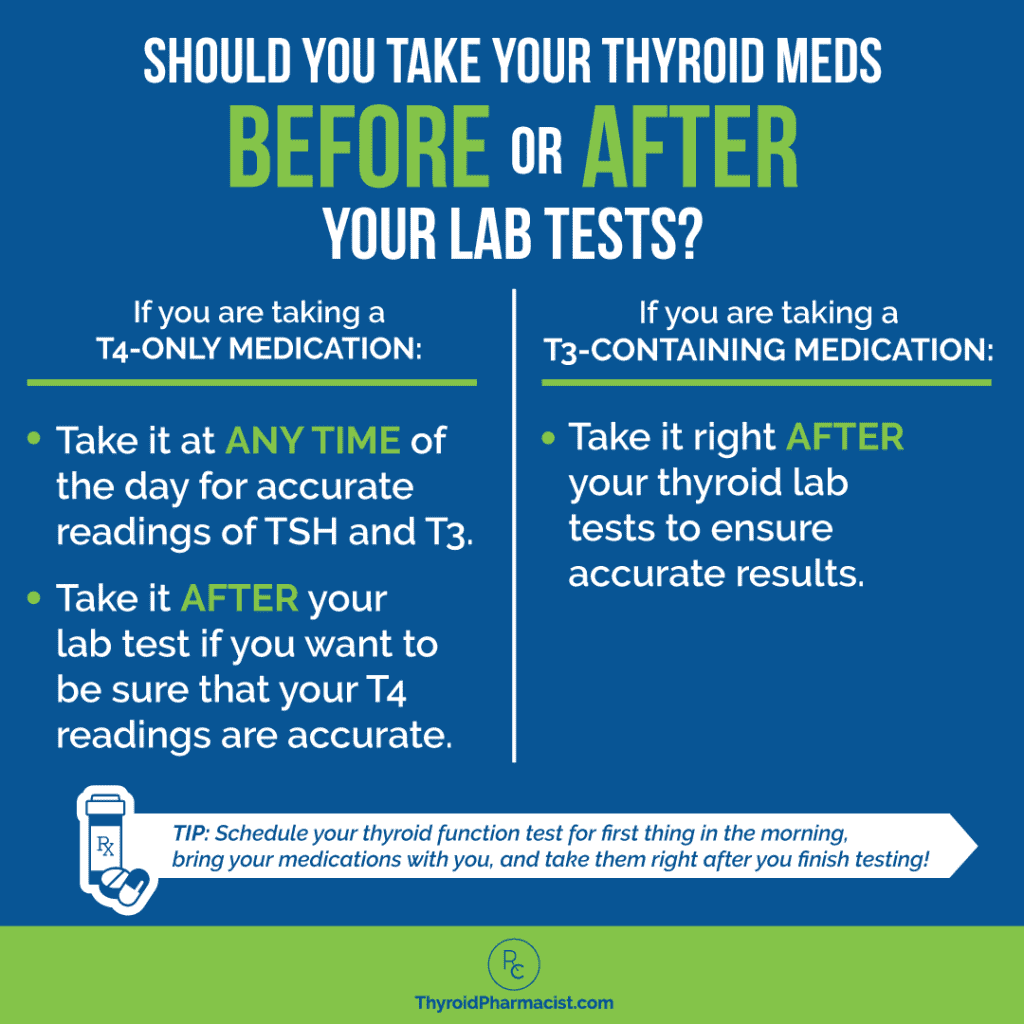
Whether you accept your T4 medication right before your lab tests or haven't taken it for up to 48 hours, your TSH value should be the same. Thus, you will go an authentic representation of your TSH value whether or not you take your T4 medication before a lab exam.
The aforementioned goes for free T3 levels when you take a T4 medication. The gratis T3 level will also be relatively constant.
Levels of free T4, however, volition acme two hours after your T4 medication is taken.
Then permit's say y'all take your T4 medication at eight am and have your blood test at 10 am – your thyroid labs may show that your T4 is falsely elevated. This may consequence in your doctor lowering your medication, when in reality, your T4 levels may exist within range for the rest of the day, with the exception of that 2-hr, postal service-dose acme.
In about cases, taking a T4 medication the morning before your lab test will not be an issue, every bit most doctors suit the dosages according to the TSH, which stays stable after T4 dosing.
However, to go a reading of your T4 levels that is reflective of most of the day, you lot would want to postpone your T4 medication until after the lab examination.
Thus, when taking T4-only medications, I generally recommend delaying your thyroid medications until after your lab test. For best results, schedule your thyroid labs early on in the morning, and bring your thyroid medications to the appointment to take them right after the lab draw.
Recommendations for Those on T3-Containing Medications
If you're taking a T3-containing medication (such every bit Cytomel or liothyronine) to optimize your free T3 levels, the timing of your tests matters.
Correct later a dose of T3-containing medications, free T3 levels tend to rise, then peak at around the iv-hour mark.
T3 has a typical half-life of 18 hours to three days. That means information technology could take less than a mean solar day for T3 levels to beginning quickly declining in your body!
So, if you were to accept a T3-containing thyroid medication a few hours before your thyroid lab tests, your lab results might testify that you have besides much T3, fifty-fifty when you may be accurately dosed. Or, they may be in the normal range, when yous are actually nether-dosed.
T3-containing medications tin also temporarily modify TSH levels. Researchers who monitored the levels of TSH, free T3, and free T4 in people with hypothyroidism who were taking combination (T3/T4-containing) medications over a 24-60 minutes period, found that TSH levels may be falsely suppressed.
This is because, correct after taking a T3-containing medication, TSH levels driblet and stay suppressed for around five hours. TSH levels will then increase until around 13 hours post-dosage, where levels volition stabilize.
So in gild to get an accurate reading of your TSH levels on a T3-containing medication, you would demand to wait at least 13 hours after taking your T3-containing medications earlier testing!
Again, for this reason, I generally recommend delaying your thyroid medications until later on your lab test. For best results, test thyroid labs early in the morning, and bring your thyroid medications to the engagement to accept them correct after the lab describe.
Recommendations for Those on T4/T3 Combination Medications
If yous're taking a combination medication that contains both T4 and T3 (such equally Armour Nature-Throid, WP Thyroid, or compounded T4/T3), the timing of your tests does affair and may brand a huge difference in getting y'all on an appropriate medication dose.
Equally mentioned above, taking any medication with T3 will showtime drop TSH levels for around five hours before they showtime rising over again. Thus, it is ordinarily best to postpone taking your T4/T3 combination medication until after you get your lab tests done.
Then over again, with this medication type, I recommend getting your thyroid function tests washed first affair in the morning earlier taking your medications, bringing your medications with you, and taking them right after you consummate your thyroid tests, to ensure that you go the nearly accurate lab results.
*Delight note: The one-half-life of T4/T3 combination medications may vary per formulation (this can vary depending on the formulation and whether information technology is an immediate or sustained release version), so some people may have a falsely suppressed TSH, even at the euthyroid state (or the land of normal thyroid part), when taking T3-containing medications.
This is when complimentary T3 and T4 testing will come in handy, as thyroid wellness can be assessed through optimal levels of free T3 and free T4. Thyroid health tin as well be determined by assessing 1'south list of symptoms.
Supplements and Medications That May Interfere with Thyroid Lab Results
Information technology's of import to note that there are some supplements and medications that tin interfere with lab results, that you should be aware of before getting thyroid lab work done:
- Biotin — The American Thyroid Association recommends that patients cease taking biotin for at least two days before a TSH test. Biotin can result in falsely loftier levels of T4 and T3, and falsely low levels of TSH on lab results. Biotin supplements (taken at 5-10 mg/day) can interfere with thyroid labs and cause a faux appearance of hyperthyroidism. There are example reports of people taking biotin and having low TSH, loftier T4, high T3, and elevated TSH-receptor antibodies (in the absence of hyperthyroid or Graves' symptoms) show up on lab results. That said, lab values practice normalize after vii days of being off biotin. If you lot're going in for a thyroid lab draw, skip the biotin for 2 days beforehand, to ensure that it doesn't interfere with the results.
- Supplements containing estrogenic compounds — Supplements that comprise estrogenic compounds such equally soy, can lead to falsely elevated TSH levels. However, please note that I do non recommend products containing soy to those with Hashimoto's, as it is one of the nearly common food sensitivities seen in those with the condition.
- Medications that interfere with thyroid examination results — In add-on to supplements, there are certain medications that can interfere with thyroid lab test results and may lead to fake readings. This type of interaction is known as a drug-lab interaction, and two common types of medications that interfere with thyroid labs include:
- Glucocorticoids, dopamine, dobutamine, and octreotide – These tin can lower TSH without indicating true thyroid dysfunction.
- Certain NSAIDs (nonsteroidal anti-inflammatory drugs) of the salicylate bracket (specifically, salsalate, diclofenac sodium, and naproxen) – These have been found to decrease serum T3 and T4 measurements).
- Drug-drug interactions — Simulated alterations of thyroid labs are non to be mistaken with drug-drug interactions, which occur between thyroid hormones and certain medications, and lead to actual changes in thyroid hormone levels. Simply stated, there are medications that interfere with thyroid lab results by actually interfering with thyroid hormone office — this ways they cause real alterations in thyroid hormone levels. Some of these alterations are clinically meaning and may require a dose adjustment of your thyroid medications when taking the two medications concurrently. I'm working on a separate commodity that goes in depth about these medications, so stay tuned!
What to Do if You Get a Questionable Lab Consequence
If you lot feel that you may have received an inaccurate lab effect (peradventure y'all've realized the timing of your thyroid medication may have interfered with its accuracy), there are steps you can take to receive a more than accurate result.
Beginning, endeavor to determine if the timing of your medication in relation to your thyroid lab tests could be a factor. Writing down the details near timing and dosages of medications may help pinpoint if and/or how your thyroid medication may accept affected your lab result(s). It may also be helpful to determine if y'all consumed additional medications and/or supplements mentioned previously, effectually the time of your thyroid testing.
If yous find that the timing of your medications and/or other factors mentioned in this article did indeed lead to inaccurate lab results, information technology may exist necessary to retest.
Retesting may involve some planning around when you take your thyroid medications, and peradventure delaying other medications and/or supplements by a few hours, so that in that location is no interference when yous practice depict your labs.
If after receiving accurate results, you all the same experience hypothyroid, are still experiencing debilitating symptoms, or if your lab results exercise non fall inside the optimal ranges (as discussed before in this commodity), be sure to re-read the "Optimizing Thyroid Medication Absorption" department of this commodity (above) to ensure you are taking your thyroid meds away from foods that can inhibit their assimilation. If yous are, then it may be time to have a chat with your doctor well-nigh adjusting your medications.
This may involve:
- Adjusting dosages
- Switching to a different type of medication — for example, many individuals feel better with calculation T3 onboard to their electric current regimen
Delight note, however, that in that location take been recalls in the past, so make sure to hash out this with your md, and bank check out this commodity on thyroid medications to review all bachelor options on the marketplace. While trying to get on the right dosage of medication, you will desire to test your thyroid labs every 4 to 6 weeks to ensure your labs are within range.
Once you lot go stabilized on your new thyroid medications, you lot can start testing thyroid levels every three months to one year for ongoing monitoring.
I have a free, downloadable eBook, Optimizing Thyroid Medications, that provides further guidance on this optimization process.
Next Steps
As mentioned in a higher place, if you are following all the steps for accurate lab results just they are still coming back abnormal, talk to your medico about a dosage aligning.
I recommend that y'all also investigate the possibility that something else is interfering with the assimilation of your thyroid medication, such as fillers like gluten, or sure supplements that you are taking.
While some supplements can result in false readings of thyroid levels, others reflect a true modify in thyroid levels — this modify may be an comeback or worsening of levels depending on the supplement. Examples of such supplements include aloe vera, cordyceps, vitamin A, and ashwagandha, which all lower TSH. (I'1000 working on an article on supplements that can help lower TSH naturally — stay tuned!)
In improver to medications that cause false alterations in thyroid lab results, in that location are besides medications that have actual drug interactions with thyroid hormones, and the altered labs are a real reflection of how the add-on of a new drug impacts the activity of thyroid hormones in the body.
In my preparation equally a pharmacist, I learned that there are some medications that have a multitude of drug interactions — 1 of these medications is thyroid hormone! Some of these drug interactions may exist clinically significant, meaning that they can alter the assimilation, distribution, metabolism or elimination of the thyroid hormones, necessitating a dosage alter in thyroid hormones while the person is taking both medications.
A person who has been stable on thyroid medications but begins experiencing symptoms of hypo- or hyperthyroidism following the addition of a new medication, should inquire most potential drug interactions and request lab tests.
I'll exist sharing more information most significant drug interactions with thyroid hormones in the future, but for at present, I recommend checking with your pharmacist whenever you lot offset a new medication to see if your dose of thyroid medication needs to be adjusted.
In summary, receiving authentic results is important to ensure no ineffective changes are made to your electric current medications, and to assess how your thyroid is currently functioning. Once y'all've identified and addressed things that could be affecting your TSH or T4 lab results, consider retesting with the proper timing of medications and/or supplements for accuracy.
I hope this helps you lot on your healing journey!
P.Due south. Yous tin can download a Thyroid Diet Guide, 10 thyroid-friendly recipes, and the Nutrient Depletions and Digestion chapter of my get-go volume for free, by signing up for my weekly newsletter! You lot will besides receive occasional updates about new inquiry, resources, giveaways, and helpful information.
For futurity updates, make sure to follow the states on Facebook and Instagram, likewise!
References
- Saravanan P, Siddique H, Simmons D, Greenwood R, Dayan C. Twenty-4 Hour Hormone Profiles of TSH, Free T3 and Free T4 in Hypothyroid Patients on Combined T3/T4 Therapy. Experimental and Clinical Endocrinology & Diabetes. 2007;115(04):261-267. doi:ten.1055/s-2007-973071.
- Food and Synthroid Drug Interactions. Drugs.com. https://www.drugs.com/drug-interactions/lemon-with-synthroid-2993-0-1463-869.html. Accessed June 9, 2021.
- American Thyroid Association. https://www.thyroid.org/patient-thyroid-information/ct-for-patients/vol-one-effect-1/vol-1-result-1-p-21/. 1(1):21. Accessed June 10, 2021.
- Dong BJ. How medications affect thyroid function. W J Med. 2000;172(two):102-106. doi:10.1136/ewjm.172.2.102
- Ardabilygazir A, Afshariyamchlou S, Mir D, Sachmechi I. Effect of High-dose Biotin on Thyroid Part Tests: Instance Written report and Literature Review. Cureus. 2018;x(6):e2845. Published 2022 Jun xx. doi:ten.7759/cureus.2845
- Clark CD, Bassett B, Burge MR. Furnishings of kelp supplementation on thyroid office in euthyroid subjects. Endocr Pract. 2003;ix(5):363-369. doi:10.4158/EP.9.v.363
- Otun, J., Sahebkar, A., Östlundh, L. et al. Systematic Review and Meta-analysis on the Effect of Soy on Thyroid Function. Sci Rep. 2019;9(3964). https://doi.org/10.1038/s41598-019-40647-10
- Koulouri O, Moran C, Halsall D, Chatterjee One thousand, Gurnell One thousand. Pitfalls in the measurement and interpretation of thyroid office tests. Best Pract Res Clin Endocrinol Metab. 2013;27(half dozen):745-762. doi:x.1016/j.beem.2013.ten.003
- Bishnoi A, Carlson HE, Gruber BL, Kaufman LD, Bock JL, Lidonnici M. Effects of commonly prescribed nonsteroidal anti-inflammatory drugs on thyroid hormone measurements. Am J Med. 1994;96(3):235-238. doi:10.1016/0002-9343(94)90148-1
- Liewendahl M, Majuri H, Helenius T. Thyroid function tests in patients on long-term treatment with various anticonvulsant drugs. Clin Endocrinol (Oxf). 1978;viii(3):185-191. doi:10.1111/j.1365-2265.1978.tb01493.x
- De Luca F, Arrigo T, Pandullo E, Siracusano MF, Benvenga Due south, Trimarchi F. Changes in thyroid part tests induced by 2 month carbamazepine treatment in L-thyroxine-substituted hypothyroid children. Eur J Pediatr. 1986;145(1-2):77-79. doi:10.1007/BF00441860
- Cooper JG, Harboe Yard, Frost SK, Skadberg Ø. Ciprofloxacin interacts with thyroid replacement therapy. BMJ. 2005;330(7498):1002. doi:x.1136/bmj.330.7498.1002
- Trifiro M, Parrino F, Sultana J, et al. Drug interactions with levothyroxine therapy in patients with hypothyroidism: observational report in general practice. Clin Drug Invest. 2015;35(3):187-195.
- Irving SA, Vadiveloo T, Leese GP. Drugs that interact with levothyroxine: an observational study from the Thyroid Epidemiology, Inspect and Research Report (TEARS). Clin Endocrinol (Oxford). 2015;82(1):136-141.
- Liwanpo L, Hershman JM. Conditions and drugs interfering with thyroxine assimilation. All-time Pract Res Clin Endocrinol Metab. 2009;23(half-dozen):781-792.
- Sachmechi I, Reich DM, Aninyei M, Wibowo F, Gupta Yard, Kim PJ. Result of proton pump inhibitors on serum thyroid-stimulating hormone level in euthyroid patients treated with levothyroxine for hypothyroidism. Endocr Pract. 2007;13(4):345-349. doi:x.4158/EP.xiii.iv.345
- McConnell RJ. Abnormal thyroid function test results in patients taking salsalate. JAMA. 1992;267(ix):1242-1243.
- Aanderud S, Myking OL, Strandjord RE. The influence of carbamazepine on thyroid hormones and thyroxine binding globulin in hypothyroid patients substituted with thyroxine. Clin Endocrinol (Oxf). 1981;fifteen(3):247-252. doi:10.1111/j.1365-2265.1981.tb00662.x
- Isojärvi JI, Turkka J, Pakarinen AJ, Kotila M, Rättyä J, Myllylä VV. Thyroid function in men taking carbamazepine, oxcarbazepine, or valproate for epilepsy. Epilepsia. 2001;42(7):930-934. doi:x.1046/j.1528-1157.2001.042007930.10
- Sodium salicylate and synthroid interactions. Drugs.com. https://world wide web.drugs.com/drug-interactions/sodium-salicylate-with-synthroid-2094-0-1463-869.html. Accessed Oct 14, 2021.
- Gamstedt A, Järnerot Thousand, Kågedal B, Söderholm B. Corticosteroids and thyroid office. Different effects on plasma volume, thyroid hormones and thyroid hormone-binding proteins after oral and intravenous administration. Acta Med Scand. 1979;205(5):379-383.
Note: Originally published in August 2015, this article has been revised and updated for accurateness and thoroughness.
Source: https://thyroidpharmacist.com/articles/how-to-get-accurate-lab-tests-when-taking-thyroid-medications/
0 Response to "How Long to Wait After Changing Thyroid Dose to Check Again"
Post a Comment