Eats Wrapped Drugs Before Plane Has to Eat Them Again
Why does food taste different on planes?
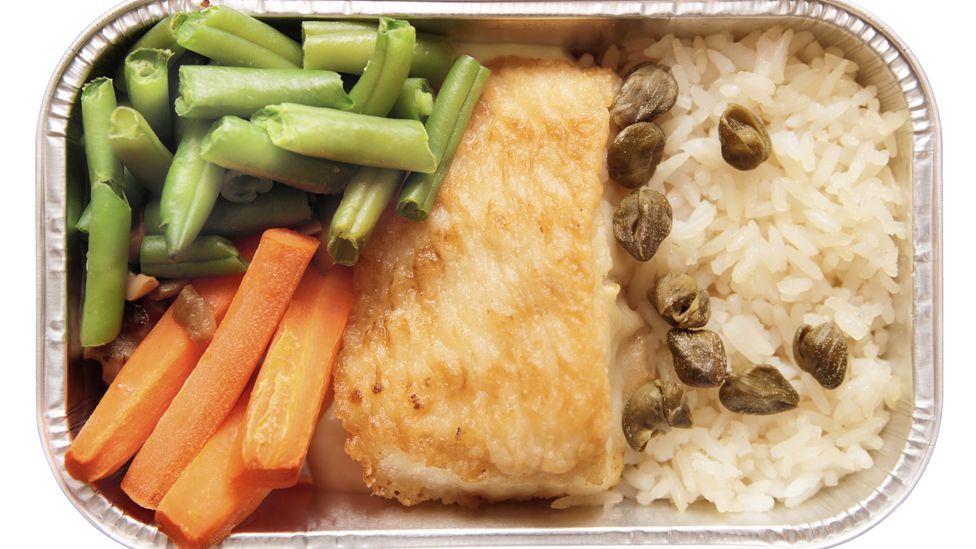
When your sense of taste buds are way above the clouds, your normal taste goes right out of the aeroplane's window. Katia Moskvitch investigates why this happens, and how airlines are trying to find ways to go our appetites back on rails.
I
If y'all recall the nutrient airline companies serve up is bland or unappetising, it's not necessarily their mistake. Essentially, you leave your normal sense of sense of taste backside at the aerodrome departure gate. Become on board a airplane and cruise to a level of thousands of anxiety, and the flavour of everything from a pasta dish to a mouthful of wine becomes manipulated in a whole host of ways that we are only beginning to empathise.
Taste buds and sense of scent are the starting time things to go at 30,000 feet, says Russ Brown, managing director of In-flight Dining & Retail at American Airlines. "Flavor is a combination of both, and our perception of saltiness and sweetness drop when inside a pressurised motel."
Everything that makes upwards the in-flight experience, it turns out, affects how your nutrient tastes. "Food and drink really do taste unlike in the air compared to on the basis," says Charles Spence, professor of experimental psychology at Oxford University. "In that location are several reasons for this: lack of humidity, lower air pressure, and the background racket."
Dryness and depression pressure level
When you lot step on an airplane, the atmosphere inside the cabin affects your sense of smell showtime. Then, as the plane gets college, the air pressure drops while humidity levels in the cabin plummet. At about 30,000 feet, humidity is less than 12% – drier than near deserts.
The combination of dryness and low pressure reduces the sensitivity of your taste buds to sweet and salty foods past around 30%, according to a 2010 study conducted by Germany'south Fraunhofer Institute for Building Physics, commissioned past German language airline Lufthansa. To investigate this the researchers used a special lab that reduced air pressure level simulating cruising at 35,000 feet (10.6km) – too equally sucking moisture out of the air and simulating the engine noise. It even made seats vibrate in its attempts to mimic an in-flight meal experience.
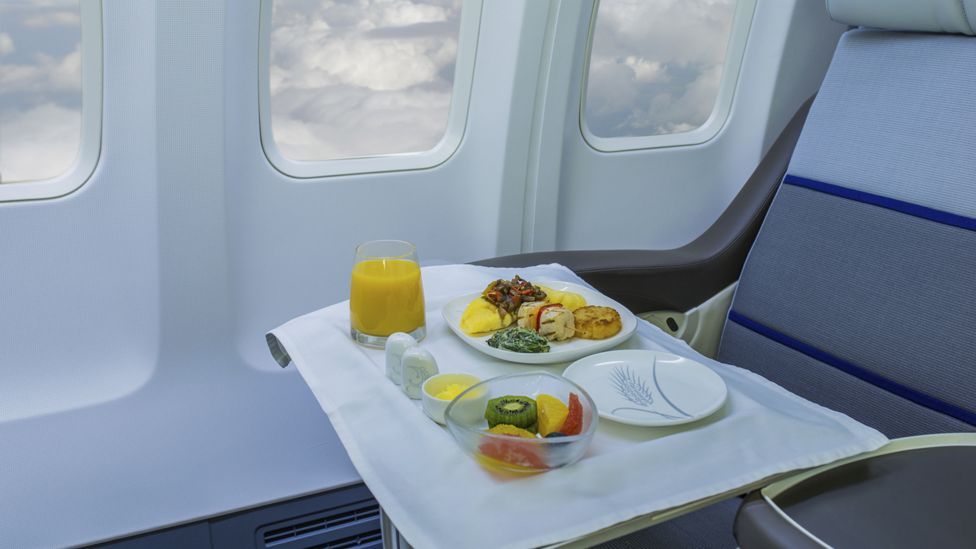
Interestingly, the study constitute that we take leave of our sweetness and salty senses only. Sour, bitter and spicy flavours are almost unaffected.
Simply it's non but almost our gustatory modality buds. Upwards to 80% of what people think is taste, is in fact odor. Nosotros need evaporating nasal mucus to scent, but in the parched cabin air our odour receptors practise not piece of work properly, and the effect is that this makes food taste twice as bland.
And then airlines have to give in-flying food an extra kick, by salting and spicing it much more than a eatery on the ground ever would. "Proper seasoning is key to ensure food tastes practiced in the air," says Brown at American Airlines. "Often, recipes are modified with additional salt or seasoning to account for the cabin dining atmosphere."
Gerry McLoughlin, executive chef at rival United states airline United, says he has to use "vibrant flavours and spices" to make in-flight meals taste "more robust".
He and his swain chefs too have the constant loud humming of the jet engines to contend with. While y'all may think that flavour is influenced by your nose and mouth, psychologists are now finding that your ears tin also play a role. (For more on this, see this video and try out a taste experiment) A study establish that people eating to the sound of loud background dissonance rated food as beingness less salty and less sweet than those who ate in silence. Another twist: to those surrounded by noise, food surprisingly appeared to sound much crunchier.
However, a plane's loud background noise of effectually 85db does not affect all tastes every bit, says Spence. For instance, seasonings like cardamom, lemon grass and back-scratch taste more intense in the sky than salt or saccharide.
Mass-produced recipes
It's not merely the in-cabin conditions that have to be taken into account. Preparing and serving tasty food for a few hundred people above the clouds is not an like shooting fish in a barrel task. Because of food prophylactic standards, all meals must be cooked on the ground. At that place the food is packed, smash-chilled, refrigerated, and finally must survive re-heating in the air. All of this would modify the flavour even if it was served at bounding main level.
To re-heat food on lath, for condom reasons virtually all airlines utilise convection ovens, which blow hot, dry air over the food. Microwaves and open flames are not allowed, although the first induction ovens are at present on the market.
"Airline chefs are unique in that they mass produce recipes for thousands of customers," says Brown. "Many times the final product is non what was originally envisioned due to things outside their control. We pattern nutrient with ingredients and packing we know tin survive the long process between food preparation and delivery."
Recently fashionable ways of cooking like sous-vide – where the food is cooked in a sealed plastic pocketbook for a long time at a relatively depression temperature - also help making in-flight food taste better, says Pam Suder-Smith, president of the International Flight Services Association.
And then to amend the quality of airline nutrient, airlines are offset to experiment with testing meals in pressurised environments or aboard actual shipping to replicate what passengers will experience.
Simulated cabin
"You can't use the same recipes for airline meals that you would use on the basis," says David Margulies of Heaven Chefs, a company specialising in catering for airlines. "Only that doesn't mean that meals served on airplanes can't taste simply every bit good. Our executive chefs have mastered the art and science of adapting recipes to changes in how food tastes at high altitudes."
So far, this proves true by and large for meals in first and concern course, though. "Charabanc meals may be less elaborate," he concedes.
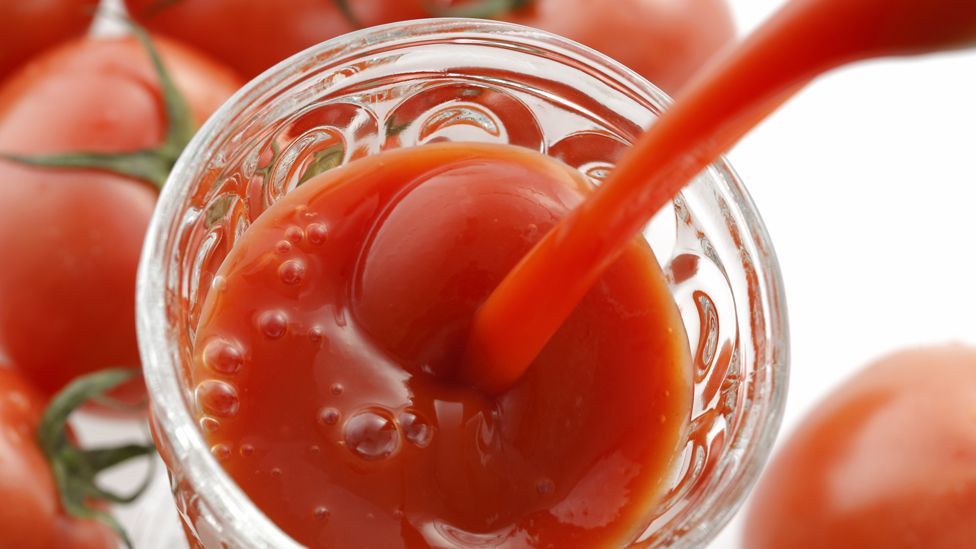
The umami notes of tomato juice seems stronger in the air than on the ground (Getty Images)
For First and Concern class, Sky Chefs apply a team of executive chefs who work with airline customers – and employ country-of-the-fine art kitchens, similar to those in a eatery. Near meals are and so placed in special carts and kept chilled until they are re-heated during the flight. "They are prepared in a mode that takes the re-heating process into account and then they are not overcooked," says Margulies.
Airlines keep finding better ways to research food preparation at altitude. Singapore Airlines, for instance, works closely with their in-flight catering provider, SATS, which has a simulated shipping cabin at their in-flight catering heart at Singapore Changi Airport, where meals are cooked and tested under low-pressure weather. "Information technology enables us to replicate the atmospheric condition of a flight at 35,000 feet and our airline has developed many in-flight dishes based on inquiry conducted in this facility," says a Singapore Airlines spokesperson.
Nasal sprays
Some of our senses, withal, are unaffected by altitude, peculiarly the and so-called fifth gustation, umami. It is the pleasantly savoury gustation imparted by foods such as sardines, seaweed, mushrooms, tomatoes, and soy sauce. "Umami taste may actually be enhanced by loud background racket," says Spence.
And because tomatoes are so rich in umami, "this links to people ordering tomato juice and Bloody Mary in the air in a way they never do on footing," he adds.
Similarly, United'southward McLoughlin is using umami-rich ingredients such as spinach, tomatoes and shellfish to raise in-flight meals.
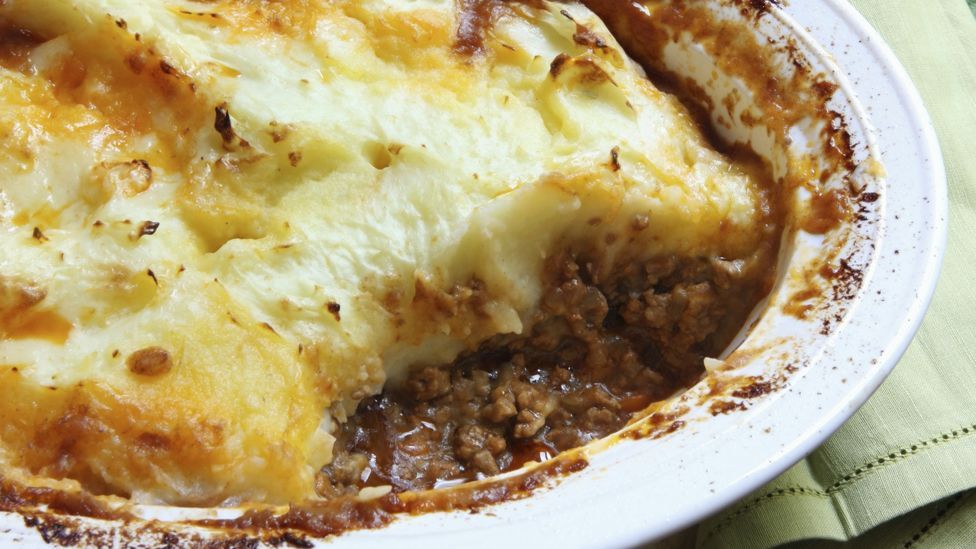
In a more than radical approach, British celebrity chef Heston Blumenthal hoped to help British Airways deliver meliorate in-flight nutrient, by distributing nasal spray to passengers to clear their sinuses before they ate. That approach proved unpopular, though. So Blumenthal resorted to umami, for example with a recipe for shepherd's pie that featured seaweed in the crust.

The champagne y'all pop at 30,000ft doesn't taste like information technology does on the ground (Getty Images)
Besides having an umami-rich carte, BA is as well introducing soundtracks to match the taste of the nutrient using noise-cancelling headphones, says Spence. Bachelor for first, business concern and economy, "it is one of the channels on all long-booty flights introduced from November, and information technology includes both semantic matches such as for instance Scottish music for Scottish fish, and more synesthetic matches designed to upwards sweetness." Synesthesia is the technical term for evoking a sensation (like gustation) through the stimulation of a unlike sense, in this case hearing.
Some airlines are also investigating whether irresolute the cutlery might assist, because when heavy cutlery is replaced by knives and forks that are light and plastic, information technology makes food taste worse, says Spence. "And the cheap plastic cups in which nosotros drinkable our gin and tonic and vino don't aid either."
'Sparse, tannic and acidic'
Speaking of wine, some varieties, notwithstanding outstanding on terra ferma, may lose their edge as soon as they are upward in the air, says Liam Steevenson, the head of United kingdom of great britain and northern ireland wine distributor Red & White, who is also one of the senior wine buyers at grocery chain Waitrose. The company used to supply business organization-but airline Silverjet for two years with the vino to get with the card designed past the eating house Le Caprice. That involved a lot of tasting and assessment of wines on the footing and then in the air, while Steevenson himself worked as a consultant for Silverjet.
"Wines that on the ground gustation quite fruity, suddenly taste thin, tannic and acidic," says Steevenson. "Wines certainly sparse out and become much bacteria and more structured. Liquids aggrandize and contract according to atmospheric pressure and therefore perhaps this is what is happening to the wine. The mid-palate is tasting less fruity equally the force per unit area changes."
To bargain with the consequence, airlines take to select wines that are fruity with low acid and low tannin. "This is not always easy – champagne is high in acid and lots of people desire to drink champagne on lath," says Steevenson. "Blood is tannic and sometimes acidic – once more lots of business organization travellers want Bordeaux – so in my heed all these buying decisions have to exist made whilst thinking nigh what volition happen to them in the air."
And because very depression humidity changes our palate perceptions, it is "probably best to beverage vino early in the flight rather than towards the stop, when we have stale out considerably more," he adds. "Equally we dry out, out gustation buds become less constructive."
Share this story on Facebook , Google+ or Twitter .
Source: https://www.bbc.com/future/article/20150112-why-in-flight-food-tastes-weird
0 Response to "Eats Wrapped Drugs Before Plane Has to Eat Them Again"
Post a Comment